

Best Lightweight Tent for Backpacking: 4 Top Picks
Oct 18 , 2026
Table of Contents
- Quick Comparison: Best Lightweight Tent for Backpacking
- How We Evaluated These Backpacking Shelters
- Trekker Tent 1A: The Budget Backpacking Tent for Solo Hikers
- Ultralight 1-Person Poleless Tent: Lightest Option for Minimalists
- Sky View Solo Tent: Best for Stargazing and Tall Solo Campers
- Trekker Tent 2.2: The Best 2 Person Backpacking Tent for Couples
- Backpacking Tent Weight: Minimum Trail Weight vs Packed Weight
- Freestanding Backpacking Tent vs Trekking-Pole Designs
- Frequently Asked Questions
Last Updated: October 14, 2026
Quick Comparison: Best Lightweight Tent for Backpacking
The best lightweight tent for backpacking matches your trip, your body, and your budget, not the lowest advertised number on the box.
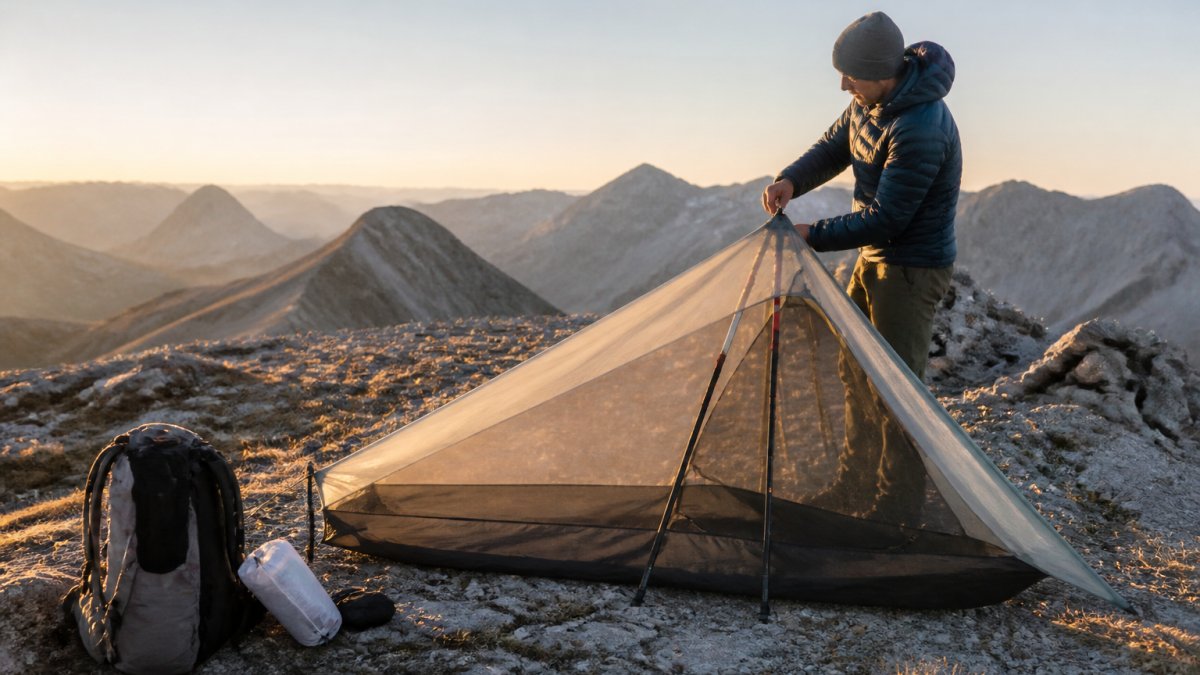
Every gram you carry uphill is a gram you feel on the descent, so the best lightweight tent for backpacking saves weight without cutting protection.
| Tent | Capacity | Packed Weight | Price | Best For |
|---|---|---|---|---|
| Trekker Tent 1A | 1 person | A few pounds | $54.00 | Budget solo hikers |
| Ultralight 1-Person Poleless | 1 person | 0.86 kg | $123.99 | Minimalists, bikepackers |
| Sky View Solo | 1 person | 3.8 lbs | $254.00 | Stargazing, tall campers |
| Trekker Tent 2.2 | 2 people | Pole-free trail weight | $103.00 | Couples, thru-hikers |
That table is the short version. Capacity and price tell you little about how a shelter performs when the wind picks up at 2 a.m.

How We Evaluated These Backpacking Shelters
Lightweight tents are often judged on four things: real packed weight, usable interior space, weather protection, and pitch speed with cold hands. Advertised "minimum trail weight" strips out stakes, guylines, and stuff sacks, so it's important to compare what actually goes in your pack.
Here is a checklist to consider for any shelter:
- Weigh the full kit, not the stripped-down minimum
- Measure floor area and peak height against your sleeping pad
- Check the waterproof rating on both the rainfly and the floor
- Count the stakes and guylines needed for a stable pitch
- Time a solo setup in wind, not on a calm lawn
That last point adds real cost. A shelter that looks cheap often is not once you buy the groundsheet it needs.
Trekker Tent 1A: The Budget Backpacking Tent for Solo Hikers
The Trekker Tent 1A is a dependable shelter for solo hikers at a competitive cost. It is a bivy-style, one-person trekking pole tent that sets up fast and packs down small, and at $54.00 it offers great value.
What makes it work is simplicity: you use your own trekking poles for support, so there is no heavy pole set to carry.
The honest limitation: bivy-style tents trade living space for weight. If you are over six feet tall or want to sit up and read, look at the Sky View Solo instead. For many, this is a strong budget backpacking tent option.
Ultralight 1-Person Poleless Tent: Lightest Option for Minimalists
At 0.86 kg with a pack size of 33 x 14 x 14 cm, the Ultralight 1-Person Poleless Tent is the lightest shelter we carry. It is built for backpackers, bikepackers, and motorbike tourers who count every gram and centimetre of pack space.

The 20D silicone-coated nylon body carries a 2000 mm waterproof rating, and the groundsheet steps up to 3000 mm, so the floor handles wet ground that would soak through a thinner base.
A few details that matter on the trail:
- Reflective elements on the guylines make the tent easier to find with a headlamp
- Repair tape is included for resealing seams
- The poleless design means one less thing to break or forget
The trade-off is interior volume: this solo shelter fits you and your sleeping bag, not your pack. Store gear in the vestibule or under the fly.
Sky View Solo Tent: Best for Stargazing and Tall Solo Campers
The Sky View Solo is an excellent tent if you sleep better under an open sky or you are taller than average.
Space is where it separates itself. The floor measures 38 x 80.5 inches with a 41-inch peak height, fitting one camper up to 6'1" tall.
The build holds up to real weather: 20D nylon ripstop body and 40D nylon ripstop floor, both with a 3000 mm waterproof coating.
Trekker Tent 2.2: The Best 2 Person Backpacking Tent for Couples
For two people, the Trekker Tent 2.2 is a highly effective 2-person backpacking tent in our range.

The interior is the headline: the footprint runs over 7 feet long and 5 feet wide, enough for two hikers plus gear storage.
At $103.00, it offers a competitive price point. For couples and thru-hikers who split the load, it presents a compelling option.
Backpacking Tent Weight: Minimum Trail Weight vs Packed Weight
Backpacking tent weight comes in two numbers, and the gap between them is where manufacturers get creative. Minimum trail weight is the tent body, rainfly, and poles only. Packed weight adds stakes, guylines, stuff sacks, and anything else in the box.
Trekker Tent 1A – 1 Person Backpacking Tent →
That difference is usually hundreds of grams, and it is the number you actually carry. A tent advertised at 1.2 kg minimum trail weight can land closer to 1.5 kg packed once you add stakes and a guyline kit, closer to 1.7 kg with a footprint and spare stakes.
The weight math most buyers get wrong
To compare shelters honestly, build a system weight for each one, every component that goes in your pack, not just the tent body.
- Tent body, rainfly, and poles, the advertised minimum trail weight
- Stake set, some tents ship with the bare minimum; count what you need for a stable pitch in wind, not a calm lawn
- Guyline kit, often sold separately or included in a short length that forces you to add more
- Footprint or groundsheet, required on thin floors, optional on puncture-resistant ones
- Trekking poles, if the shelter is poleless, the poles you carry are part of the system weight even though they serve double duty
- Stuff sacks and repair kit, small, but they add up
A common pattern: a shelter that looks lightest on the spec sheet becomes the heaviest option once you add the footprint it needs and the stakes it should have shipped with. The reverse is also true, a tent with a slightly higher minimum trail weight but a puncture-resistant floor and full stake set can end up lighter on the trail because you leave the footprint at home.
How to weigh your own setup
A kitchen scale is enough. Weigh the tent body, rainfly, and poles together, then the stake bag, guyline kit, stuff sack, and footprint separately. Add them up, that total is your real packed weight.
For a solo hiker, a few hundred extra grams rarely changes the trip. For a thru-hiker covering long distances day after day, that weight compounds. The American Hiking Society guidance on pack weight makes the same point: every item earns its place or gets left behind.
Freestanding Backpacking Tent vs Trekking-Pole Designs
A freestanding backpacking tent holds its shape with its own pole structure, so you can pick it up and move it after pitching. A trekking-pole tent uses the poles you already carry, cutting weight and pack size but requiring stakes or anchor points to stand. What matters more is how each behaves in wind, on ground that will not take a stake, and when something breaks.
Field performance: wind, rain, and marginal pitches
Freestanding designs have a structural advantage in wind because the pole set creates a continuous frame, though they still need staking out in strong gusts, poles keep them upright, guylines keep them from folding.
In rain, the difference is mostly pitch speed and seam exposure. A trekking-pole tent typically pitches fly-first or as a single unit, keeping the inner dry during setup.
Total system cost: the number competitors hide
A trekking-pole tent looks cheaper because it skips the pole set, but that math only works if you already carry trekking poles.
Freestanding tents include their poles, so the sticker price is closer to the real cost; they still need stakes and sometimes a footprint, but the structural system is in the box. Compare system cost: shelter plus poles plus stakes plus footprint plus guylines.
Durability and repairability
Pole sets are the most common failure point on freestanding tents. Aluminum poles can bend or crack, and replacement sections usually ship from the manufacturer but take time.
Fabric wear follows a similar pattern: both designs use lightweight nylon or polyester and benefit from a footprint on abrasive ground. The difference is in field repairs. A bent pole can sometimes be straightened enough to finish a trip; a torn seam or ripped stake-out point needs repair tape and a careful pitch.
Which one to choose
If you already hike with trekking poles, the weight savings are essentially free, and a trekking-pole shelter is the lighter, smaller option. If you do not, factor in the cost and weight of a pole set before comparing prices. If you camp on hard ground, in exposed wind, or sustained rain, a freestanding tent is easier to live with. If you count every gram and centimetre of pack space, a trekking-pole design earns its place.
Frequently Asked Questions
What is a good weight for a backpacking tent?
For solo backpacking, a good target is under 1 kg (about 2.2 lbs) for the tent body and rainfly, with trekking-pole designs hitting that range most easily. Two-person shelters typically land between 1 and 1.8 kg. The Ultralight 1-Person Poleless Tent weighs 0.86 kg, while the Trekker Tent 1A is described as weighing just a few pounds. Lighter tents usually trade interior volume or freestanding convenience, so match the weight to how far you actually walk.
What is the difference between tent trail weight and packed weight?
Trail weight is the tent body, rainfly, and poles only, the minimum you carry if you skip stakes and stuff sacks. Packed weight includes everything that ships in the box: stakes, guylines, repair tape, and the footprint if one is included. The Sky View Solo lists 3.8 lbs packed and includes a footprint, so its trail weight is lower than that figure. Always compare the same measurement when weighing two tents against each other.
Are freestanding tents better for backpacking?
Freestanding tents stand up on their own poles, so they work on rock slabs and hard ground where stakes will not bite. Trekking-pole tents like the Trekker Tent 1A and Trekker Tent 2.2 are lighter and pack smaller but need stakes or guyline anchors to hold shape. If you hike with poles and mostly camp on soil, a trekking-pole shelter saves weight. If you camp on exposed rock or want to shift position after pitching, freestanding is the safer bet.
Is a 2-person tent big enough for two backpackers?
It depends on the interior footprint. The Trekker Tent 2.2 lists over 7 feet of length and 5 feet of width, which fits two hikers plus gear storage along the sides. Tighter two-person tents force you to leave packs in the vestibule or outside. If you are both over 6 feet tall or carry bulky sleeping pads, check floor dimensions before buying rather than trusting the capacity label alone.
How much should I spend on a lightweight backpacking tent?
You can cover a solo shelter for around $54 to $124 and a two-person option near $103 in this lineup, with the Sky View Solo at $254 for stargazing mesh and a footprint included. Spending more buys specialized features like panoramic mesh, internal rainfly control, or lighter fabrics, not basic weather protection. Set a budget based on trips per year: a weekend camper gets more value from the Trekker Tent 1A than from a premium solo shelter.
Choosing a shelter is really a question of matching weight, space, and protection to the trip in front of you. Wild For Wellness Co stocks all four of these tents so you can compare real specs side by side, from the $54.00 Trekker Tent 1A to the stargazing Sky View Solo with its included footprint and 6-month no-hassle warranty. Explore Now and find the lightweight shelter that fits how you actually camp.