

Big and Tall Sleeping Bags: Fit, Size & Warmth Guide
Oct 14 , 2026
Table of Contents
- Why Standard Sleeping Bags Fail Big and Tall Campers
- Sleeping Bags for Tall People: Length, Width, and Hip Girth
- XXL Sleeping Bags: What to Look For Beyond the Label
- Sleeping Bag Size Chart: Matching Your Measurements to a Bag
- Sleeping Bag Temperature Ratings: What the Numbers Really Mean
- Insulation, Weight, and Packability for Larger Frames
- How to Choose Big and Tall Sleeping Bags by Use Case
- Conclusion: Getting the Fit Right the First Time
- Frequently Asked Questions
Last Updated: October 14, 2026
Why Standard Sleeping Bags Fail Big and Tall Campers
Most sleeping bags are built for an average body that doesn't exist. The core problem with big and tall sleeping bags: the market treats them as a niche when a large share of campers need them.

The consequences go beyond mild discomfort.
Many campers express frustration with "extra long" bags online that are still too narrow across the chest. The fix starts with three measurements, not one.
Sleeping Bags for Tall People: Length, Width, and Hip Girth
The right bag for a tall person fits on three axes: length, shoulder width, and hip girth. Most shoppers only check length, which is why so many tall campers end up with a bag that's long enough but still feels like a straitjacket.
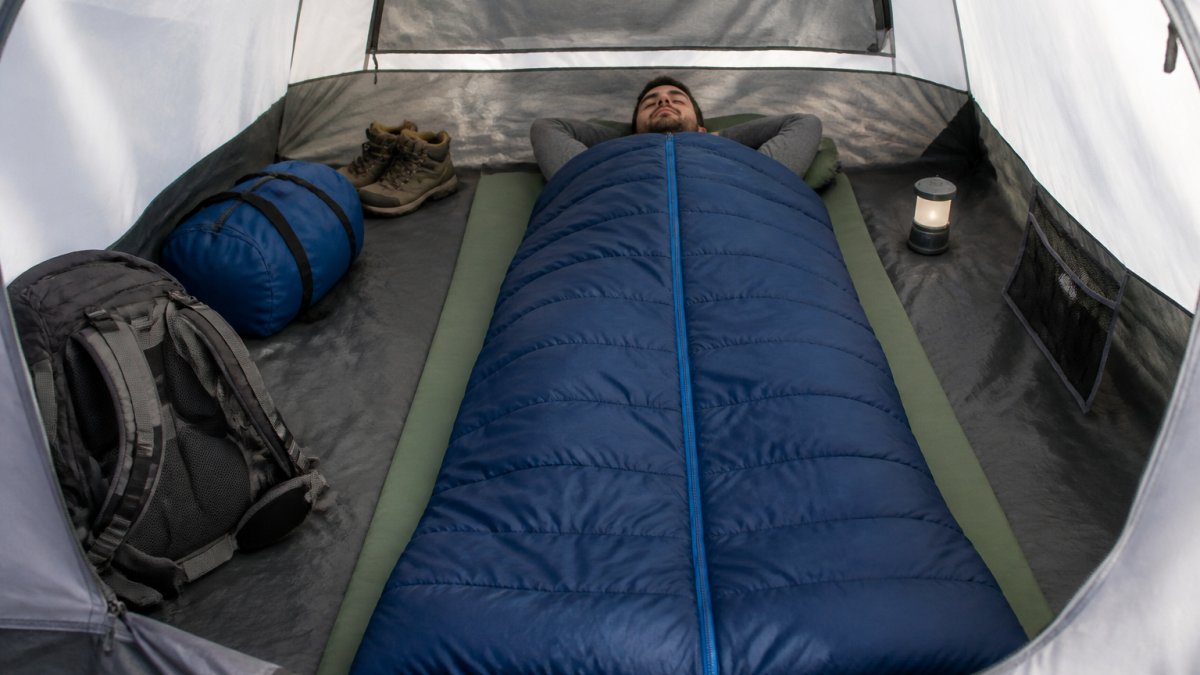
How Much Extra Length Do You Need?
Add roughly 4 to 6 inches of buffer beyond your standing height. A 6-foot-4 camper should look for an internal length of at least 6 feet 8 inches. That buffer matters because footbox insulation needs loft to trap warm air; if your toes press against the fabric, the loft collapses and cold seeps in.
Interior Width and Room to Roll Over
Shoulder girth is where most "tall" bags quietly fail. A bag that's long enough but only 30 inches wide at the shoulders will still restrict a broad-shouldered sleeper. Look for at least 34 to 36 inches across the shoulders and a comparable hip girth if you sleep on your side or shift positions. Side sleepers need extra hip width specifically, because that's where the body bends.
XXL Sleeping Bags: What to Look For Beyond the Label
"XXL" on a product page means almost nothing on its own.
What matters is the spec sheet: published interior dimensions for length, shoulder girth, hip girth, and footbox width.
Our XXL Sleeping Bag for Big and Tall Campers is built with an extra-large design that provides additional room for big and tall campers.
Beyond dimensions, check the shape. Rectangular bags offer the most room and freedom, while mummy bags save weight but taper aggressively at the feet.
Sleeping Bag Size Chart: Matching Your Measurements to a Bag
A size chart only works if the numbers you feed it are accurate. Most shoppers guess their height and ignore girth entirely, which is why so many big and tall campers end up with a bag that's long enough but still too tight. Measure yourself the way a bag actually fits: lying down, in the position you sleep in.
How to Measure Yourself for a Sleeping Bag
Do this once, write the numbers down, and keep them on your phone before you shop.
- Height (barefoot): Stand against a wall and mark the top of your head. This sets your minimum bag length.
- Shoulder circumference (lying down): Lie flat on your back, arms relaxed, and run a soft tape around the widest part of your shoulders and upper back. Shoulders spread when horizontal, standing measurements undershoot by 1-2 inches for many people.
- Hip circumference (lying down): Measure around the widest part of your hips and seat while flat. Side sleepers should measure with knees slightly bent, the position that stresses hip girth.
- Foot length and width: Measure heel to longest toe, then add 4-6 inches of buffer. A wide forefoot needs a wider footbox, not just a longer bag.
Sleeping Bag Size Chart
Use this chart as a starting point, then confirm against the specific bag's published interior specs. Sizes vary by maker, so treat these as minimums.
| Your Height | Minimum Bag Length | Shoulder Width Needed | Hip Girth Needed | Typical Category |
|---|---|---|---|---|
| Up to 5'10" | 6'0" | 30-32" | 28-30" | Standard |
| 5'10" to 6'2" | 6'4" | 32-34" | 30-32" | Long |
| 6'2" to 6'6" | 6'8" | 34-36" | 32-34" | Big and tall |
| Over 6'6" | 7'0" | 36"+ | 34"+ | XXL / oversized |
Two measurements decide your row: standing height and widest girth. If you're tall but slim, length is your priority. If you're average height but broad, width and hip girth matter more. Campers who are both tall and broad must satisfy every column.
Fit Adjustments by Sleeping Position and Body Shape
A chart gives you a baseline, but how you sleep changes what you need.
- Side sleepers: Add 2-4 inches to the hip girth requirement. Your hips and knees push outward, and a snug hip section restricts you all night. Look for a wider hip section or a stretch panel.
- Stomach sleepers: Footbox width matters more than shoulder width, because your feet splay outward. A rectangular or semi-rectangular cut beats a tapered mummy.
- Broad shoulders: Prioritize shoulder girth over length. A 6'0" camper with 52-inch shoulders may fit better in a big and tall bag than a standard long bag.
How to Read a Sleeping Bag Spec Sheet
Reputable makers publish interior dimensions: length, shoulder girth, hip girth, and footbox width. If a listing doesn't state these numbers, treat that as a red flag. What to compare:
- Interior length vs. your height: 4-6 inches of buffer so the footbox insulation can loft.
- Shoulder girth vs. your shoulder circumference: At least 2-4 inches of extra room so insulation doesn't compress against your body.
- Hip girth vs. your hip circumference: Same rule, 2-4 inches of buffer, more if you're a side sleeper.
A sleeping bag size chart is only as good as the measurements you feed it. Take your height barefoot, then measure shoulder and hip circumference while lying flat. Write the numbers down before you shop, and compare them to interior specs, not exterior footprint.
XXL Sleeping Bag for Big Tall Campers Outdoor Comfort →
Sleeping Bag Temperature Ratings: What the Numbers Really Mean
Temperature ratings describe the lower limit at which a bag keeps an average sleeper warm, not the temperature at which you'll be comfortable. A 20°F bag isn't promising cozy sleep at 20°F; it's promising survival-level warmth at that threshold for a typical adult.
Several factors shift that number in practice. A bag that fits too tightly compresses insulation and performs worse than its rating; one that's too loose lets warm air circulate away.
Three-Season vs. Cold-Weather Bags
Three-season bags are the workhorse category for most campers, designed for spring through fall conditions where nighttime temperatures stay above freezing. Cold-weather bags add insulation and a warmer rating for winter trips and below-freezing nights.
For big and tall campers, the trade-off is sharper. Extra interior space means more air to warm, so a roomy bag often needs a slightly warmer rating than a snug one for the same comfort.
Insulation, Weight, and Packability for Larger Frames
Bigger bags use more insulation and fabric, which means more weight and bulk, simple physics, and the trade-off every tall camper weighs against comfort. A big and tall bag can easily weigh 1-2 pounds more and pack 30-50% larger than a comparable standard bag.
Down vs. Synthetic: What Changes for Larger Frames
Down insulation delivers the most warmth per ounce but costs more and loses performance when wet. Synthetic is heavier and bulkier but keeps working in damp conditions, which matters in wet climates. For larger frames, insulation quality matters more than type, because you're asking a bigger volume of air to stay warm.
Here's how the trade-offs shake out:
- Down (600-800 fill power): Best warmth-to-weight ratio. A 20°F down bag for a big and tall camper might weigh 3-4 pounds and pack to the size of a large watermelon. Requires a dry sack in wet conditions.
- Synthetic (e.g., Climashield, PrimaLoft): Heavier and bulkier, a comparable 20°F synthetic bag might weigh 4-5 pounds and pack to duffel size. Keeps insulating when damp, a real advantage in the Pacific Northwest or on rainy multi-day trips.
- Hybrid designs: Down in the core, synthetic in the footbox or hood where moisture accumulates. A good compromise for big and tall campers who want warmth without synthetic's full weight penalty.
Packability: The Real Cost of Extra Room
Packability is where oversized bags take their biggest hit. A roomy bag won't compress into the same tiny stuff sack as a mummy bag, so a compression sack helps.
To put numbers on it: a standard 20°F mummy bag might pack to 8-10 liters, while a big and tall 20°F bag of similar warmth might pack to 14-20 liters, roughly a small backpack.
Weight and Packability Trade-Offs by Use Case
| Use Case | Priority | Typical Bag Weight | Typical Packed Size |
|---|---|---|---|
| Car camping / festivals | Comfort and space | 4-6 lbs | 20-30 L |
| Weekend backpacking | Balance | 3-4 lbs | 12-18 L |
| Long-distance backpacking | Weight and pack size | 2.5-3.5 lbs | 8-14 L |
| Cold-weather trips | Warmth | 4-6 lbs | 18-25 L |
Weight follows the same logic: a generously sized bag weighs more than a minimalist one. Decide up front whether your priority is a light pack or a full night's sleep, because you rarely get both. For backpackers, a common strategy is a bag wide at the shoulders and hips but tapered at the feet, saving weight without sacrificing room where you need it most.
How to Choose Big and Tall Sleeping Bags by Use Case
Match the bag to how you actually camp, not an idealized version of it. The right pick for a weekend car camper looks nothing like the right pick for a thru-hiker.
- Car camping and festivals: Prioritize interior space and comfort. Weight and packed size matter least, so a roomy rectangular bag is ideal.
- Weekend backpacking: Balance comfort against pack weight. Look for a long, wide bag with decent insulation and a compression sack.
- Cold-weather trips: Choose a warmer rating than you think you need, and confirm the bag fits loosely enough to keep insulation lofted.
Conclusion: Getting the Fit Right the First Time
The mistake we see most often is buying on length alone and discovering the bag is still too tight across the shoulders. Get your measurements first, match them to published interior specs, and treat the "XXL" label as a hint rather than a promise.
Frequently Asked Questions
What size sleeping bag is right for a 6-foot man?
A 6-foot sleeper needs a bag with an interior length of at least 78 to 80 inches. Standard bags often top out around 72 to 75 inches, which forces you to curl up or leaves your head pressed against the fabric. Look for a bag listed as long or extra-long, and check that the width gives you room to roll over without compressing the insulation.
How wide should a sleeping bag be for a comfortable fit?
Measure your shoulder and hip circumference, then add at least 4 to 6 inches of breathing room. Most standard bags are 30 to 33 inches wide at the shoulders, which feels tight for larger frames. A bag with 36 inches or more across the shoulders and 34 inches at the hips lets you move without pressing against the shell and losing warmth.
How do sleeping bag temperature ratings work in real conditions?
Temperature ratings assume you are wearing a base layer and sleeping on a pad with a decent R-value. The comfort rating is the temperature at which an average sleeper stays warm, while the lower limit is the point where you will be cold but not in danger.
Do rectangular sleeping bags offer more room than mummy bags?
Yes, rectangular bags give you noticeably more shoulder and hip room, which matters if you are broad-shouldered or move around in your sleep. The trade-off is weight and warmth: mummy bags trap heat more efficiently because they hug the body. For car camping and festivals, a rectangular XXL bag is often the better pick. For backpacking, look for a wide mummy cut instead.
Finding gear that actually fits your frame shouldn't mean settling for a bag that's merely less uncomfortable than the last one. Wild For Wellness Co builds the XXL Sleeping Bag for Big and Tall Campers with an extra-large design, a spacious interior for real room to move, and a soft, portable construction that works for camping, hiking, and travel alike. Explore Now and get a bag sized for your body, so your next trip starts with a full night's sleep.