

Coleman Sundome Dome Tent: Sizes, Setup & Rain Test
Oct 13 , 2026
Table of Contents
- Coleman Sundome Dome Tent: Sizes, Setup, and Rain Performance
- Coleman Sundome Tent Dimensions: Realistic Capacity by Size
- Coleman Sundome Tent Setup: Step-by-Step and Time to Pitch
- Coleman Sundome Tent Waterproofing: Rainfly, Seams, and Leakage
- Coleman Sundome vs. Skydome: Which Dome Tent Fits Your Trip?
- Ventilation, Doors, and Interior Comfort for Camping Conditions
- Durability, Repairability, and Long-Term Value
- Conclusion: Who Should Buy the Coleman Sundome Dome Tent?
- Frequently Asked Questions
Last Updated: October 14, 2026
Coleman Sundome Dome Tent: Sizes, Setup, and Rain Performance
The Coleman Sundome Dome Tent has stayed one of the most recognizable camping shelters for years, earning that reputation through simplicity rather than hype.
What most buyers get wrong is assuming all sizes behave the same. A two-person Sundome and a six-person Sundome differ in floor area, headroom, packed weight, and rain behavior once you add the fly. Below, we break down the Coleman Sundome dome tent by size, walk through setup, and give a realistic read on waterproofing.
Coleman Sundome Tent Dimensions: Realistic Capacity by Size
Coleman Sundome tent dimensions vary by model, and stated capacity assumes you're lying shoulder to shoulder with no gear. Plan for one fewer person than the label suggests if you want floor space for bags, boots, and a lantern.
Here's how the sizes compare in real terms:
| Size | Typical Floor Shape | Realistic Sleepers | Best For |
|---|---|---|---|
| 2-person | Narrow rectangle | 1 adult comfortably | Solo trips, backpacking |
| 4-person | Wide rectangle | 2 adults + gear | Couples, weekend camping |
| 6-person | Full rectangle | 3-4 adults + gear | Families, car camping |
The honest read: a 4-person Sundome is a comfortable two-person tent, and a 6-person is comfortable for three to four, standard industry math.
Floor Area and Headroom: What the Numbers Mean in Practice
Headroom in a dome tent peaks at the center and drops fast toward the walls.
A common mistake is buying on peak height alone. What matters more is usable floor area under that peak, in a dome, roughly the middle third is where you'll actually move around.
If you're taller than about 6 feet, check peak height before buying so you can sit up without your head brushing the ceiling.
Packed Size, Weight, and Portability
Portability splits cleanly by size. The two-person packs small enough for a car trunk and short carries, the four-person is manageable for one person over a short distance, and the six-person is a car-camping tent, full stop.
Check the packed weight before you buy. If you're driving to the site, weight barely matters. If you're walking more than a few hundred meters, it matters a lot.
Side-by-Side Comparison Across Capacities
Most reviews cover one size in isolation. The table below pulls the key decision specs together so you can compare capacities at a glance, then verify current numbers on the product page for your model year, since Coleman has updated fabrics and pole designs over time.
| Spec | 2-Person | 4-Person | 6-Person |
|---|---|---|---|
| Floor dimensions (approx.) | Narrow rectangle, roughly 7 x 5 ft | Wide rectangle, roughly 9 x 7 ft | Full rectangle, roughly 10 x 10 ft |
| Center height (approx.) | Around 4 ft | Around 4 ft 11 in | Around 6 ft |
| Doors | 1 | 1 | 1 |
| Sleeps (advertised) | 2 | 4 | 6 |
| Sleeps (realistic) | 1 adult + gear | 2 adults + gear | 3-4 adults + gear |
| Packed weight (approx.) | Lightest of the three | Mid-weight | Heaviest, car-camp only |
| Packed size | Fits a car trunk easily | Manageable for one person | Bulky, best stored in vehicle |
| Best use | Solo trips, short carries | Couples, weekend camping | Families, base camping |
Two patterns stand out. Center height scales faster than floor area, which is why the 6-person feels dramatically roomier than the 4-person despite a modest footprint difference. And packed weight climbs steeply with capacity, so the 6-person crosses from "carryable" to "vehicle-only" for most people.
Realistic Sleeping Capacity and Usable Floor Space
Advertised capacity is a marketing number, not a comfort guarantee. Here's how to translate it:
- Sleeping pads: A standard adult pad is roughly 20-25 inches wide and 72-78 inches long. Two side by side eat about 4 feet of width, leaving a narrow strip for gear in a 4-person Sundome.
- Luggage: A duffel or gear bin takes roughly the footprint of a third sleeping pad, so one per person subtracts a full sleeping spot from advertised capacity.
- Group size: Two adults and two kids fit a 6-person Sundome comfortably; four adults with gear will feel tight and should size up or leave gear in the car.
A simple rule: buy one size larger than the number of people sleeping in the tent.
Standard vs. Dark Room Versions
Some Sundome models come in a Dark Room variant, using darker fabric and a reflective coating to reduce morning light and heat. The trade-offs:
- Light reduction: Dark Room fabric blocks meaningful early-morning sunlight, helping if you sleep past sunrise or nap during the day. It does not make the tent pitch black.
- Heat: The reflective coating reduces heat buildup on sunny days, but the tent then depends more on ventilation. Keep the rear vent and door mesh open when conditions allow.
- Ventilation: Because the fabric blocks more light and radiant heat, airflow matters more; a standard Sundome with more mesh may feel breezier on hot, humid nights.
In warm, sunny climates where you value sleeping in, the Dark Room version is worth the premium. In mild or cool conditions where you want maximum airflow, the standard Sundome is simpler.
Coleman Sundome Tent Setup: Step-by-Step and Time to Pitch
Coleman Sundome tent setup is one of the fastest in its category, and that speed is the tent's core selling point. Two people can pitch it in a few minutes; one person takes a bit longer.
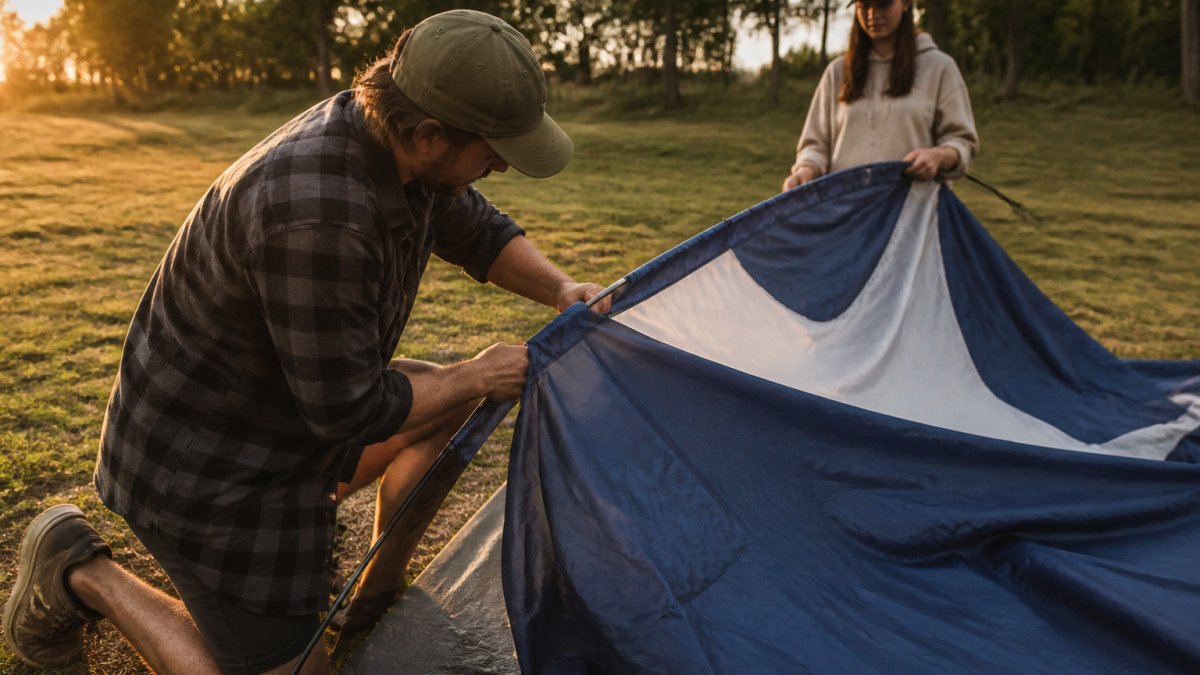
Here's the sequence we'd follow:
- Clear the ground of rocks and sticks, then lay out the footprint or a ground tarp.
- Unfold the tent body and orient the door toward your chosen direction.
- Assemble the shock-corded poles and thread or clip them in, depending on your model year.
- Insert the pole ends into the corner grommets and let the dome pop up.
- Stake the four corners at a slight outward angle for tension.
- Drape the rainfly over the top and clip it at the corners.
- Stake out the fly's vestibule or guy lines if your model has them.
A common mistake is skipping the corner stakes before adding the fly. The tent flexes, the fly sits crooked, and rain pools in the wrong spot.
Packing It Back Into the Carry Bag
Getting the tent back in the bag frustrates most people. Fold it loosely rather than matching the factory crease, lay the poles flat against the folded body, roll tight, and slide it in. It takes a couple of tries the first time, then it's routine.
Coleman Sundome Tent Waterproofing: Rainfly, Seams, and Leakage
Coleman Sundome tent waterproofing depends heavily on how you pitch it, not just the fabric coating. The hooded rainfly covers the top and upper walls but not the full floor, so in steady rain water can reach the lower walls and door base if the fly isn't tensioned correctly.
Where leakage usually happens:
- Seams where the fly meets the pole clips, if the fly is loose.
- The door flap if it's not fully zipped and the zipper storm flap isn't seated.
- The floor corners if the tent is pitched on a slope and water runs underneath.
Our recommendation: always use a ground tarp, stake the fly out tight, and re-tension the guy lines after the first hour of rain. Fabric relaxes when wet, and a fly that was tight at pitch time can sag.
Coleman Sundome vs. Skydome: Which Dome Tent Fits Your Trip?
The Coleman Sundome vs. Skydome question comes up often, and the answer depends on how you camp. Both are three-season dome tents from the same brand, but the Sundome favors a proven, low-cost design while the Skydome favors faster setup and more usable interior volume.
Here's how they actually differ:
| Feature | Sundome | Skydome |
|---|---|---|
| Pole design | Traditional pole-through-sleeve or clip design | Pre-attached poles that fold out with the tent body |
| Setup time | A few minutes for two people; longer solo | Noticeably faster, especially solo, because poles are already attached |
| Wall profile | Classic dome curve, sloped walls | More vertical walls, which increases usable interior volume for the same footprint |
| Interior headroom | Peaks at center, drops toward walls | More consistent headroom because walls are steeper |
| Door design | Single D-shaped door on most sizes | Single door with a more vertical entry |
| Price | Generally lower | Generally higher |
| Best for | Budget-conscious campers who don't mind a few extra minutes at pitch time | Campers who prioritize speed, solo setup, and interior space |
Setup and Pole Design
The biggest practical difference is the pole system. The Sundome uses shock-corded poles you thread through sleeves or clip to the body, depending on model year, reliable, but it takes a few minutes and is easier with two people. The Skydome's pre-attached poles stay connected to the body, so you unfold the tent and the poles are already in place, making solo setup faster and reducing the chance of losing a pole section.
Interior Volume and Headroom
The Skydome's more vertical walls give it an edge in usable space. In a traditional dome like the Sundome, the ceiling slopes steeply, so floor area near the walls is only good for sleeping; the Skydome's steeper walls let you sit up closer to the edges, making it feel larger than its footprint suggests. If you're tall or want room to move around, that geometry is a real advantage.
Weather Protection and Ventilation
Both are three-season shelters with similar rainfly coverage and mesh ventilation, and neither is designed for heavy snow or sustained high winds. The Sundome's rainfly covers the top and upper walls but doesn't reach the floor, so site selection and proper staking matter in steady rain; the Skydome follows a similar approach with ventilation panels and a rear vent to manage condensation.
Which Should You Buy?
Choose the Sundome for a proven design, lower entry price, and if you don't mind a few extra minutes at pitch time, solid for weekend campers, families, and first-time dome tent buyers. Choose the Skydome if speed and interior headroom matter more than price, better for solo campers, people who set up in the dark, and anyone wanting more usable space without sizing up.
Ventilation, Doors, and Interior Comfort for Camping Conditions
Ventilation comes through mesh panels in the upper body and a rear vent, which helps with condensation on cool nights. The single D-shaped door is easy to enter and exit with the fly on, though a second door would help in larger sizes. Interior comfort comes down to airflow, floor space, and gear storage: wall pockets keep small items off the floor, and when temperatures swing, keep the fly's vents open during the day and closed at night.
Durability, Repairability, and Long-Term Value
Durability is where the Sundome is honest about what it is. The polyester fabric and fiberglass poles hold up across many seasons of normal use, but they're not built for sustained high winds or heavy snow loads. Repairability is a quiet strength: pole sections can be replaced individually and fabric tears patched with standard tent repair tape, so a damaged Sundome doesn't have to become a landfill item.
Conclusion: Who Should Buy the Coleman Sundome Dome Tent?
The Coleman Sundome dome tent is the right call for three-season campers who want a shelter that pitches fast, vents well, and protects against steady rain when set up correctly. It's not for alpine conditions or extended backcountry trips, it's for weekend trips, family car camping, and anyone who wants a reliable dome that doesn't ask much of them.
At Wild For Wellness Co, we stock shelters and gear built for the same principle: dependable performance when conditions change. If you're outfitting your next trip and want equipment that holds up without overcomplicating the experience, explore our camping collection and gear up with confidence.
Frequently Asked Questions
Is the Coleman Sundome tent good for camping?
For three-season weekend camping, yes. The Coleman Sundome dome tent is built for fair-weather trips and light rain, with a simple pole structure, a hooded rainfly, and mesh panels for airflow. It suits casual campers who want a low-fuss shelter rather than a four-season mountaineering tent. If you camp in heavy storms or deep winter, look at a tent with a full-coverage fly and stronger poles.
How many people fit comfortably in a Coleman Sundome tent?
Treat the stated sleeping capacity as a maximum, not a comfort figure. A two-person Sundome fits two sleeping pads with almost no room for bags. A four-person model sleeps two adults plus gear comfortably, and a six-person version works well for three or four people with duffels inside. Check the Coleman Sundome tent dimensions before buying if you carry bulky pads or a large dog.
Is the Coleman Sundome tent waterproof?
The tent uses a coated polyester fabric and a hooded rainfly, which handles steady rain when it is pitched correctly. Coleman Sundome tent waterproofing depends on setup: stake the fly taut, keep the fabric off the walls, and seal or re-seal seams over time. Leakage usually comes from a sagging fly or ground water, not the fabric itself. A footprint or tarp under the tent helps.
What is the difference between the Coleman Sundome and Skydome tents?
The main difference is the pole and door design. The Skydome uses a pre-attached pole structure that pitches faster and has a wider door opening, while the Sundome relies on a more traditional sleeve-and-pole build. The Coleman Sundome vs. Skydome choice comes down to setup speed and entry space versus the classic layout. Both are three-season dome tents aimed at casual and weekend campers.
The challenge with any tent is matching it to the trip you actually take, not the one you imagine. The Sundome rewards campers who pitch it properly, stake it out, and use it within its design limits. If you want gear that supports that same honest approach to outdoor adventure, Wild For Wellness Co offers durable shelters, climbing equipment, and recovery tools built for real conditions. Explore Now and find the setup that fits how you camp.