

5 Best Lightweight Sleeping Bags for Cold Weather
Oct 27 , 2026
Table of Contents
- What Makes a Lightweight Sleeping Bag Suitable for Cold Weather
- Sleeping Bag Temperature Ratings: How to Read Comfort and Lower Limit
- Down vs. Synthetic Sleeping Bags: Which Insulation Handles Cold Better
- How to Stay Warm in a Sleeping Bag: A Complete Sleep System
- Packed Weight, Packability, and the Real Cost of Lightweight Bags
- Fit, Sizing, and Durability: What to Check Before You Buy
- Conclusion
- Frequently Asked Questions
Last Updated: October 21, 2026
What Makes a Lightweight Sleeping Bag Suitable for Cold Weather
Lightweight sleeping bags for cold weather keep you warm at temperatures near or below freezing while staying light enough to carry all day. That balance of warmth and weight is the whole game. At Wild For Wellness Co, we see the same pattern every season: campers buy a bag rated for the cold, then discover the rating told them almost nothing about how warm they'd actually sleep.
Three things decide whether a bag earns its place in a cold-weather pack.
Insulation quality and loft. Warmth comes from trapped air, not from fabric thickness. Loft is how much the bag puffs up when you shake it out. A bag that lofts high and recovers quickly holds warmth better than one that flattens under its own weight.
Shell and construction. A wind-resistant shell, a well-sealed hood, and a draft tube behind the zipper matter as much as the fill. Cold air finds every gap you leave open.
A rating you can trust. Most manufacturers publish a comfort rating and a lower limit. Those numbers come from standardized testing, and they assume you're wearing a base layer and sleeping on an insulated pad. Ignore that context and a "cold weather" bag can feel thin at 2am.
The real mistake is shopping by temperature label alone. A bag rated for deep cold but paired with a summer pad will sleep cold. Warmth is a system, and the bag is one part of it.
Sleeping Bag Temperature Ratings: How to Read Comfort and Lower Limit
Temperature ratings are test results, not promises. A bag's comfort rating is the temperature at which an average sleeper stays comfortable. The lower limit is the coldest temperature at which an average person can sleep without shivering, typically in a curled position. Those are two different numbers, and manufacturers often lead with the more impressive one.
Here's what most guides miss: the ratings assume a full sleep system. Standardized tests use a defined base layer and a sleeping pad with real insulation value. Swap in a thin foam pad and your effective warmth drops, sometimes by a full comfort band. That's why two people in the same bag can report completely different nights.
A few practical rules we'd give any camper:
- Buy to the comfort rating, not the lower limit, if you sleep cold.
- Add a margin of a few degrees for wind, damp, and fatigue.
- Check whether the rating is for men or women; women's bags are often rated differently.
- Treat the rating as a starting point and adjust with a liner or extra layer.
For a consistent way to compare bags, look at the standardized sleeping bag rating test (EN 13537) methodology. If a manufacturer doesn't state which standard it used, ask. A rating without a stated method is marketing, not data.
Down vs. Synthetic Sleeping Bags: Which Insulation Handles Cold Better
Down insulation wins on warmth-to-weight and packability. Synthetic insulation wins on wet-weather performance and price. That's the honest summary, and the choice comes down to how wet your trips get.
Down is goose or duck plumage. Its fill power number describes how much space an ounce of down lofts into. Higher fill power means more warmth for less weight, which is exactly what a lightweight cold-weather bag needs. Down also compresses small and lasts for years if cared for. The catch: down loses loft when soaked, and a wet down bag is a cold bag.
Synthetic insulation is made from polyester fibers. It keeps trapping warmth even when damp, dries faster, and costs less. It's heavier and bulkier for the same warmth, and it degrades faster over years of compression.
For cold, dry conditions, down is the better tool. For wet coastal trips, humid climates, or multi-day rain, synthetic is the safer bet.
| Factor | Down | Synthetic |
|---|---|---|
| Warmth-to-weight | Best | Good |
| Packed size | Small | Larger |
| Performance when wet | Poor | Retains warmth |
| Durability | Long, with care | Shorter |
| Price | Higher | Lower |
| Best for | Cold, dry alpine | Wet, humid, budget |
Whichever you pick, store the bag uncompressed and wash it sparingly with a proper cleaner. Loft is the asset, and compression is its enemy.
How to Stay Warm in a Sleeping Bag: A Complete Sleep System
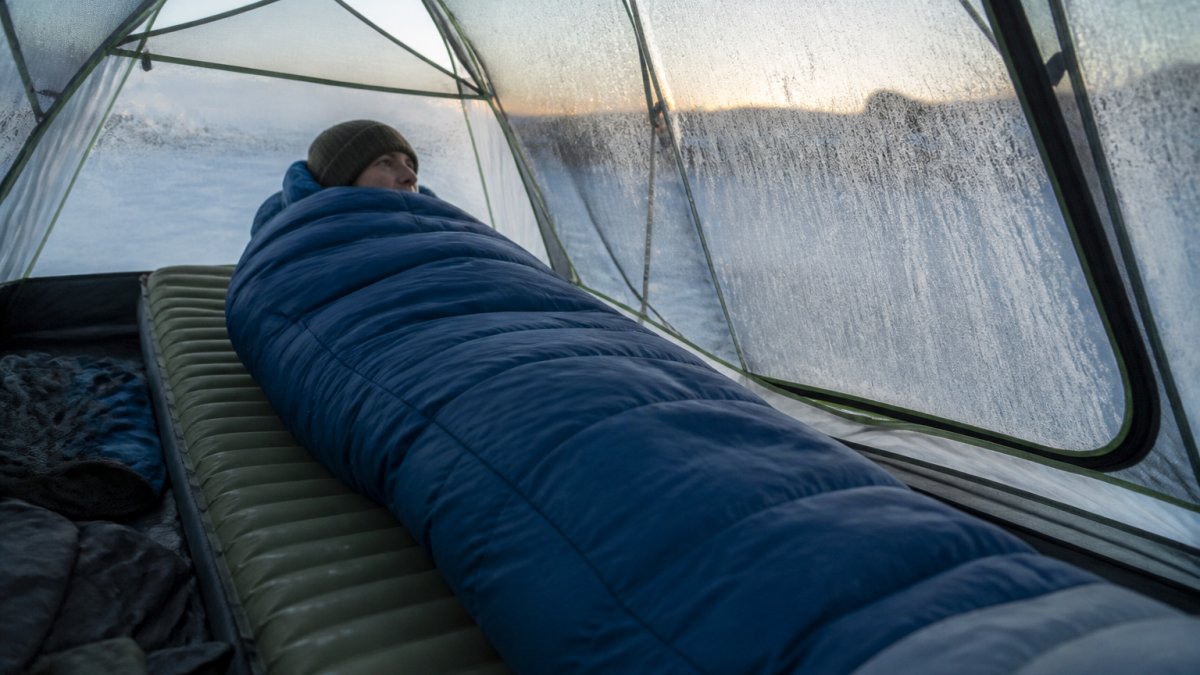
Staying warm in a sleeping bag is less about the bag and more about what surrounds it. A cold-weather sleep system has four parts: an insulated pad, a bag with a good hood and draft collar, a dry base layer, and a barrier against drafts.

Start underneath. Your body loses heat into the ground all night. A pad with real R-value (its measure of resistance to heat flow) does more for your warmth than upgrading the bag. Pair a cold-rated bag with a summer pad and you'll sleep cold no matter what the label says.
Then manage moisture. Sweaty base layers trap cold. Change into dry, dedicated sleep clothes before bed, and keep a warm hat on. Your head and neck lose heat fast, so use the hood and cinch the draft collar snug.
A few habits that make a real difference:
XXL Sleeping Bag for Big Tall Campers Outdoor Comfort →
- Eat a solid meal before bed; digestion generates heat.
- Fill a bottle with hot water, seal it, and tuck it near your core.
- Vent the tent to reduce condensation, but block drafts at your feet.
- Use a sleeping bag liner for a few extra degrees without much weight.
Packed Weight, Packability, and the Real Cost of Lightweight Bags
Packed weight and packed volume are the two numbers backpackers should compare first. A bag's packed weight is what it adds to your pack; packed size is how much room it eats in a compression sack. For cold-weather trips, both climb, and that trade-off is where most buying decisions get made.
Lightweight sleeping bags save weight in three ways: higher fill-power down, thinner shell fabrics, and tighter cuts. Each has a cost. Thinner shells are lighter but less abrasion-resistant. Tighter cuts save weight but feel confining for side sleepers and bigger frames.
To make the trade-offs concrete, here is how the key variables typically shift as you move from a three-season bag to a cold-weather lightweight bag:
| Variable | Three-season bag | Lightweight cold-weather bag | What it means for you |
|---|---|---|---|
| Fill power (down) | 600-700 | 800-900+ | Higher fill power packs smaller for the same warmth |
| Shell fabric | 30D-40D | 10D-20D | Lighter but more prone to abrasion; use a liner |
| Packed weight | 1.5-2 lb | 2-3 lb | The cold-weather bag adds roughly a pound |
| Packed volume | 5-8 L | 8-12 L | Expect it to fill more of your pack |
| Temperature rating | 30°F comfort | 15-20°F comfort | Colder rating requires more insulation |
These ranges are typical, not universal. Always check the manufacturer's stated packed weight and volume for the specific bag you're considering, and compare like for like: some brands list weight without the stuff sack, others with it.
What most reviews skip is fit. A bag that's too short compresses the loft at your feet and shoulders, and compressed loft doesn't insulate. If you're tall or broad-shouldered, an extra-large cut is worth the grams. Our XXL Sleeping Bag for Big and Tall Campers is built around that idea: extra room so bigger campers can move and sleep without crushing the insulation, in a portable design that packs for camping, hiking, and festivals.
Price tracks weight closely. Ultralight cold-weather bags sit at the premium end, and the premium buys materials and construction, not magic. For most weekend campers, a mid-weight bag with a good pad is the smarter spend. The key is to match the bag's packed weight and volume to your pack capacity and the conditions you actually face, not to chase the absolute lightest number.
Fit, Sizing, and Durability: What to Check Before You Buy
Fit and durability decide whether a bag lasts a season or a decade. Check these before you commit.
Fit. Lie in the bag if you can. Your toes shouldn't press the end, and your shoulders shouldn't strain the shell. Side sleepers need more room at the knees and hips. A roomy bag sleeps warmer than a tight one that crushes its own loft.
Sizing for real bodies. Most sleeping bags come in regular and long lengths, and some brands offer short and wide options. Our XXL Sleeping Bag for Big and Tall Campers is designed for exactly that: extra room so bigger campers can sleep without crushing insulation, while still packing down for the trail.
Zippers and baffles. Run the zipper its full length. It should glide without snagging, and the draft tube behind it should sit flush. Baffle construction, the internal walls that hold insulation in place, stops cold spots from forming. Check that the baffles are continuous and that the hood cinches snugly around your face without blocking your mouth.
Shell and seams. Look for a water-resistant shell and clean, tight stitching. Check the hood and draft collar for a snug, adjustable fit. A draft collar that seals at the neck is one of the most overlooked warmth features.
Durability and care. Down bags last longest when stored loose and washed rarely with a down-specific cleaner. Synthetic bags tolerate more abuse but flatten sooner. A sleeping bag liner protects the interior and adds warmth, and a compression sack should compress without straining seams.
Conclusion
Choosing a lightweight sleeping bag for cold weather comes down to matching insulation, rating, and fit to the conditions you actually camp in. Get the pad and layers right, read the comfort rating honestly, and pick a bag that lets your insulation loft instead of crushing it.
At Wild For Wellness Co, we build gear for exactly that kind of trip: premium equipment designed for dependable performance in changing conditions, all-day comfort, and the confidence to go farther. Explore our camping and sleep gear, and set up a sleep system that keeps you warm from dusk to dawn.
Frequently Asked Questions
What temperature rating should I choose for a cold-weather sleeping bag?
Match the bag's comfort rating, not its lower limit, to the coldest night you expect. A bag rated for -5°C comfort is a reasonable starting point for three-season alpine use, while winter camping often calls for -10°C or lower. If you sleep cold, add a margin of about 5°C. Pair the bag with a pad rated for the same conditions, because the ground pulls heat away faster than the air.
Are down or synthetic sleeping bags better for cold weather?
Down insulation offers the best warmth-to-weight ratio and packs smaller, which matters for backpacking and alpine use. Synthetic insulation keeps more of its loft when damp and dries faster, so it suits wet, humid climates and budget-focused buyers. For dry cold, down is usually the lighter choice. For wet cold, synthetic is more forgiving. Either way, a water-resistant shell and a dry compression sack protect the fill.
How much should a lightweight winter sleeping bag weigh?
For backpacking in cold conditions, aim for a packed weight of roughly 1.0 to 1.5 kg for a down bag rated around -5°C to -10°C comfort. Synthetic bags in the same range typically weigh 1.5 to 2.0 kg. Ultralight models can drop below 1 kg but often trade durability or roominess. Always compare packed weight with the temperature rating, not on its own, since a light bag that sleeps cold is a false economy.
How do you stay warm in a sleeping bag on the coldest nights?
Start with a sleeping pad with a suitable R-value, since insulation beneath you matters as much as the bag. Wear a dry base layer and a warm hat, use the hood and draft collar, and keep the zipper draft tube sealed. Eat a snack before bed and do light movement to warm up. A sleeping bag liner adds warmth, and a dry bag prevents moisture from reaching the insulation.