

Best Camping Tent for Two People: 2026 Buyer's Guide
Oct 25 , 2026
Table of Contents
- Start With Your Trip Type, Not the Tent
- How Much Two-Person Tent Size Do You Actually Get?
- When a 2-Person Backpacking Tent Makes Sense
- Choosing a Lightweight Tent for Two People
- Weather Protection, Ventilation and Season Ratings
- Pitching, Campsite Selection and Common Mistakes
- The Coleman Sundome Dome Tent and Other Options Compared
- Conclusion
- Frequently Asked Questions
Last Updated: October 21, 2026
Start With Your Trip Type, Not the Tent
The best camping tent for two people matches how you actually camp, not the spec sheet. A backcountry shelter is dead weight at a drive-in campground, and a roomy car-camping dome becomes a burden once you carry it more than a mile.
At Wild For Wellness Co, we see shoppers compare by price and capacity alone, then discover on trip one that they bought for the wrong scenario. Before you look at a single model, answer three questions.
- How far will you carry it? If the answer is "from the trunk to the site," weight matters far less than interior space and headroom.
- What weather will you meet? Summer fair-weather camping and shoulder-season storms call for different rainfly coverage and ventilation.
- How many nights per year? A weekend or two a year favors value and easy setup. Regular trips justify spending more on durability and weather protection.
How Much Two-Person Tent Size Do You Actually Get?
A two-person tent rarely gives two adults generous room. Listed capacity assumes narrow pads and still bodies, so a tent rated for two is snug for two and comfortable for one.
Sleeping Capacity vs Real Usable Space
Manufacturers count capacity by fitting the maximum number of standard pads side by side. Real comfort depends on floor dimensions, peak height, and wall slope: a dome loses usable width near the floor, while vertical walls keep it.

When you read a spec sheet, check these numbers:
| Spec | What It Tells You | What to Watch For |
|---|---|---|
| Floor dimensions | Raw footprint for pads and gear | Subtract a few centimetres per side for sloped walls |
| Peak height | Sitting-up room and changing space | Below roughly 100 cm feels tight for two adults |
| Doors | Entry and exit without climbing over your partner | Two doors ease midnight trips |
| Vestibule | Covered storage outside the sleeping area | Small or missing vestibules push wet gear inside |
| Packed size | How it rides in a pack or trunk | Bulky rolls are fine for car camping only |
For two adults plus gear, plan on a floor at least 130 cm wide and 210 cm long; treat anything less as a solo tent you occasionally share.
When a 2-Person Backpacking Tent Makes Sense
A 2-person backpacking tent earns its keep when every gram is on your back, trading interior volume and standing room for low weight and a small packed size.
The Trekker Tent 2.2 is our pick here. It uses your own trekking poles for support, so there are no poles to carry.

Setup runs about 60 seconds once you know the pitch, and the puncture-resistant floor lets you leave the ground cloth at home.
- Best for: thru-hikers, bikepackers, and anyone covering real distance
- Trade-off: needs trekking poles or a ridge line to stand, and offers less headroom than a dome
Choosing a Lightweight Tent for Two People
A lightweight tent for two people should cut weight without cutting the features that keep you dry. The trick is knowing which savings are smart and which leave you wet at 2 a.m.
Trail Weight, Minimum Weight and Packed Size
Trail weight is what the tent weighs in real use: body, rainfly, poles, and stakes. Minimum weight strips out stakes and stuff sacks, so it always looks better than reality. Compare trail weights, and add any footprint or ground cloth you plan to bring.
Packed size matters as much as weight for backpacking; a long, fat stuff sack fights for space in a 50-litre pack. For car camping, favor comfort instead.
Weather Protection, Ventilation and Season Ratings
Weather protection is where two-person tents separate quickly: a shelter that sleeps two comfortably in July can fail in a September squall. The variables that matter most are rainfly coverage, seam construction, and condensation management.
Rainfly Coverage and Seam Construction
A full rainfly that extends low on the body and stakes out over the vestibule sheds wind-driven rain far better than a partial cap. Look for a fly that reaches within a few centimetres of the ground on the windward side, and check whether the vestibule has its own staked-out floor.
Seam treatment matters as much as coverage. Taped or welded seams stop water from wicking through stitching; untreated seams weep in sustained rain unless you seal them.
Ventilation and Condensation Management
Condensation is the quiet killer of two-person tent comfort. Two adults exhale roughly a litre of moisture overnight, which condenses on the coldest surface, usually the inner wall or the underside of the rainfly.
- Mesh panels on the inner body let humid air escape; a tent with mesh on only one side traps moisture on the other.
- Ground vents at the foot and head pull cooler, drier air in and push humid air up and out.
- A fly with vents or a gap between fly and ground on the leeward side gives moisture an exit without letting rain in.
Single-wall tents breathe less than double-wall designs and condensate more in humid, still conditions. If you camp mostly in damp climates, a double-wall design with generous mesh is safer.
Trekker Tent 2.2 | 2-Person Backpacking Tent →
What Three-Season and Four-Season Ratings Actually Mean
Season ratings are a rough guide, not a guarantee:
- Three-season tents handle spring through fall, including rain and moderate wind. They are not designed for snow load or sustained winds above roughly 30-35 mph, and their mesh-heavy bodies lose heat fast in freezing conditions.
- Four-season tents add stronger poles, more guy-out points, and reduced mesh to handle snow load and high wind, at the cost of weight, airflow, and condensation in warmer weather. A four-season tent used in summer becomes a sauna.
- Single-layer designs suit mild, humid conditions where airflow beats insulation, but they are not a winter shelter.
A practical rule: match the tent to the worst weather you realistically expect, not the average. If your trips run into shoulder-season storms, prioritize a full-coverage fly and sturdy poles over a few grams of weight savings, and never treat a three-season tent as a winter shelter.
Pitching, Campsite Selection and Common Mistakes
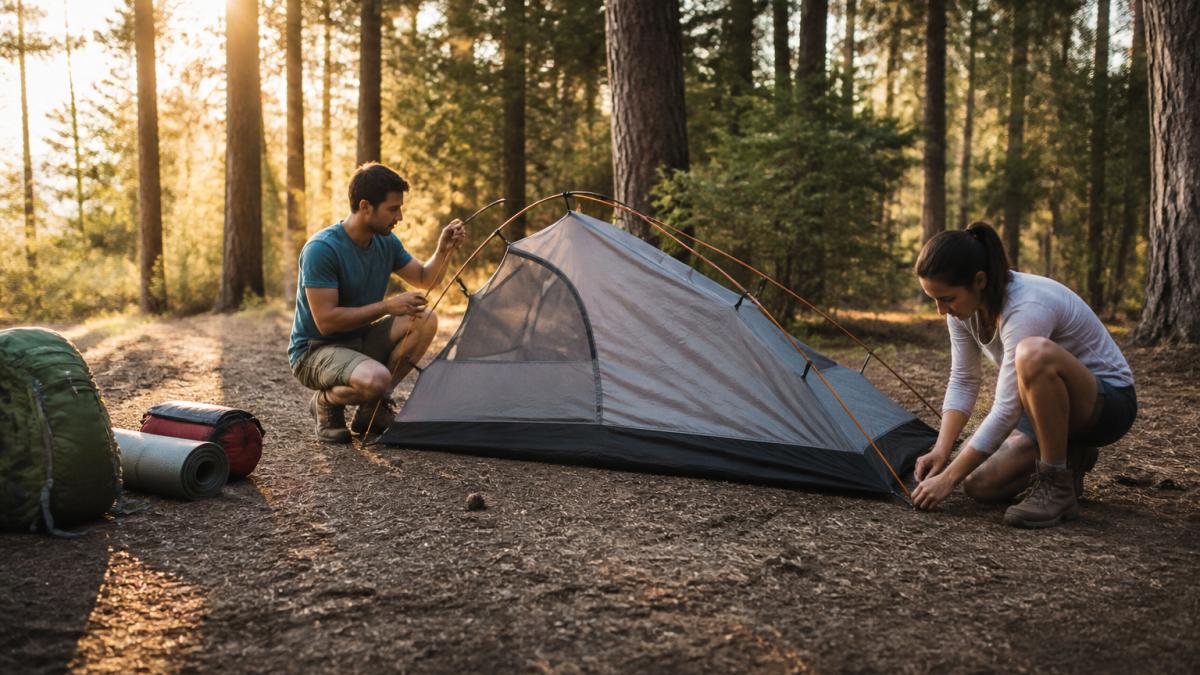
Most pitching problems are campsite problems in disguise. A tent that feels flimsy is usually pitched on a slope, in a wind funnel, or over a root, and no pole configuration fixes a bad site. The sequence below works for freestanding domes and trekking-pole shelters alike.
Choosing the Site Before You Unpack
Pick the site before you open the stuff sack, because the best pitch on a bad site still fails:
- Level ground, a slight slope is fine for drainage, but sleeping on an incline slides you downhill all night. Test by lying down before you stake anything.
- Wind direction, face the low, aerodynamic end of the tent into the prevailing wind so gusts hit the strongest part of the frame. In exposed terrain, use a natural windbreak (trees, a rock wall, a vehicle) rather than pitching in the open.
- Overhead hazards, check for dead branches, loose rock, and widow-makers before you commit. A calm night does not cancel a falling limb.
A Rain-Ready Pitch Routine
This routine works for almost any freestanding or trekking-pole shelter, and the order matters when weather is closing in:
- Lay out the footprint and stake the four corners while the floor is still loose, this lets you shift the tent to fit the site before tension locks it in place.
- Assemble the poles or set your trekking poles to the marked height. For trekking-pole shelters, get the height right first; a pole set too high or low changes the whole pitch.
- Raise the frame, then tighten guy lines in a cross pattern so tension is even. Overtightening one corner pulls the walls out of shape and stresses the pole.
- Fit the rainfly and stake out the vestibule before the first cloud arrives, a fly flapping in wind is much harder to secure than one staked in calm.
- Re-tension everything after the fabric settles. New fabric stretches slightly; a pitch that was tight at setup can sag by morning.
Common Mistakes That Cost Dry Nights
- Pitching on a slope, you will slide, and condensation runs to the low corner.
- Skipping guy lines in calm weather, the first gust arrives at 2 a.m., and the fly is already loose.
- Staking the rainfly too tight so it touches the inner wall, contact between fly and inner transfers condensation straight into your sleeping bag.
For more on campsite selection and leave-no-trace practices, the Leave No Trace guidelines are a solid reference.
The Coleman Sundome Dome Tent and Other Options Compared
Value shoppers should start with the Coleman Sundome dome tent, a classic freestanding design balancing price, ventilation, and weather protection.
Here is how our current lineup compares for two-person use:
| Tent | Price | Capacity | Best For | Key Strength |
|---|---|---|---|---|
| Trekker Tent 2.2 | 103.00 | 2 person | Backpacking, bikepacking | Ultralight trekking-pole pitch, over 7 ft floor |
| Coleman Sundome | 99.99 | 4 person | Weekend car camping | WeatherTec protection, easy pole sleeves |
| Coleman Skydome | 139.99 | 4 person and up | Couples wanting space | Near-vertical walls, pre-attached poles |
| World Famous Sports Front Range | 20.00 | 3 person | Budget weekends, festivals | Low price, 7 x 7 ft footprint |
| Single-Layer Camping & Beach Tent | 106.98 | 3 to 4 person | Park days, beach, light camping | Two doors, simple setup |
The Sundome and Skydome both list four-person capacity, making either a roomy two-person shelter with duffel space. The Skydome's nearly vertical walls add headroom; the Sundome keeps the price lower.

For official safety guidance on carbon monoxide and camp stove use inside tents, check the U.S. Consumer Product Safety Commission.
Conclusion
The hardest part of buying a two-person tent is resisting the urge to shop by price before you know your trip type.
Wild For Wellness Co stocks shelters for every scenario, from the ultralight Trekker Tent 2.2 with its trekking-pole pitch to the weather-ready Coleman Sundome and the roomy Skydome. Explore the collection and pitch the right tent for your next trip.
Frequently Asked Questions
Are two-person tents actually comfortable for two adults?
It depends on the floor dimensions, not the label. A tent sold as two-person usually fits two sleeping pads side by side with little room left over, so check the actual width before you buy. Look for at least 130 cm of floor width if you want shoulder room, and treat any listed capacity as a maximum rather than a comfort rating. Couples who want space for duffels or a dog often size up to a three-person model. The Trekker Tent 2.2, for example, lists an interior footprint over 7 feet long and 5 feet wide, which leaves room for two hikers plus gear.
What size tent is best for two people?
For two adults sharing a tent, a floor of roughly 210 x 130 cm is the practical minimum, and anything from 220 x 150 cm upward gives noticeably more comfort. Peak height matters too: under about 100 cm and you will be dressing while lying down. If you camp from a car and carry bulky gear, a larger dome or cabin-style tent pays off. If you hike in, a compact two-person backpacking tent is the better trade. Measure your sleeping pads first, then add 20 to 30 cm of width for elbows and gear.
Is a two-person tent suitable for backpacking?
Yes, as long as you check trail weight and packed size before buying. A lightweight tent for two people that splits between two packs is far easier to carry than one person hauling the whole shelter. Trekking-pole designs save the most weight because you leave the poles at home and use your own. The Trekker Tent 2.2 uses trekking poles for support and pitches in about 60 seconds, which suits hikers covering long distances. For short overnight trips with a short walk in, a standard freestanding dome tent is simpler and cheaper.
What should I look for when buying a two-person camping tent?
Prioritise five things: real floor dimensions, trail weight, a full-coverage rainfly, mesh ventilation to limit condensation, and a setup you can manage alone in wind or rain. Add a vestibule if you want somewhere to leave muddy boots, and check whether the tent is freestanding, since non-freestanding designs need stakes or guy lines to hold shape. Season rating matters as well. Most three-season tents handle spring through autumn, but none of them are winter shelters. Finally, confirm what is in the box: stakes, guy ropes and a carry bag save you a second purchase.